Motown and Me
Mo than music

I have always been a huge fan of Motown music. Give me the Supremes, Marvin Gaye, Stevie Wonder, Smokey Robinson, The Four Tops, Lionel Richie, with or without The Commodores and you will find me in my happy place. But topping the list is and always will be The Temptations.
Almost one year ago my husband and I attended a performance of “Ain’t Too Proud: The Life and Times of The Temptations” at Shea’s Performing Arts Center here in Buffalo. What a fabulous show in an incredible venue! We Buffalonians are proud of Shea’s, and rightfully so. Built in Baroque Revival style to resemble the grand opera houses of Europe, this historic venue opened in 1926, dodged the wrecking ball in the 70s, and restored to its original glory, it has earned a place in the National Register for Historic Places. What a great venue for an iconic show.


For your information, the first live Temptations concert I attended was March 12, 1969 at Kleinhans Music Hall, another of Buffalo’s National Historic Landmarks, with an international reputation as one of the finest concert halls in the United States. It is considered one of the most acoustically perfect music halls in the world. From Rock music, to jazz, to philharmonic concerts, and more, every performance I’ve ever witnessed there has unequivocally substantiated that claim ten-fold. That performance by the Temptations in the gem of acoustic perfection was legendary, albeit without David Ruffin who had been replaced by Dennis Edwards in 1968.


The 2025 show’s subtitle “The Life and Times of The Temptations” highlights the coming into existence of this iconic group during an era that coincided with my own life and times. It brought me back in time in a powerfully emotional and unexpected way. Fortunately for me, there was a packet of tissues tucked into my purse.
Interspersed with the music, performed by astoundingly talented tribute artists sounding eerily like the originals, was the life story of the members of this group that embodied the music we call Motown. Otis Williams, Melvin Franklin, Paul Williams, Eddie Kendricks, and Elbridge “Al” Bryant faced racism, oppression, poverty, addiction, and all forms of man’s inhumanity against others. Their artistry is crystalized by their life experiences and the hurdles and obstacles they had to overcome to earn their exalted place in the music world. Many of their songs reflect the harsh reality of being black in America. The price they paid to achieve fame was much higher than one might have imagined.
Against the advice and preferences of the group’s managers and handlers, their political and social stances became theme songs and anthems for the prevailing anti-war, anti-racism, anti-discrimination, anti-poverty viewpoints. Motown Records had concerns about losing the band’s mainstream audience so any music that reflected the turbulent times was refused release or passed along to other artists. It wasn’t until they began working with producer Norman Whitfield that the group embraced “psychedelic soul” as a way to tackle political issues, including the Vietnam War’s impact on American society. I embraced their music for their politics as much as for their harmonies, vocals, choreography, and exquisite virtuosity.
I freely admit to having participated in sit-ins, campus strikes, and marches, while living with the general outrage over the cruelty of war in general and Vietnam in particular. Yes, I was a long-haired, bell-bottom-jeans-wearing, Dr. Scholl’s-sandal-loving Hippie, minus the drugs. My disdain for the war in Indochina, which was never actually declared a war, was never directed at the troops, only for the government that sent our servicemen and women there. I make it a point to acknowledge and thank every veteran I encounter.

I tried to be on the right side of history by protesting the “armed conflict”, the undeclared war that cost the lives of 58,000 servicemen and women, 46,215 of which occurred from 1967-1970 during my high school years. Our senior class was divided between Hawks and Doves. Hawks supported American involvement in Vietnam because they saw the conflict as evidence of communist expansion. The Doves argued that the conflict in Vietnam did not directly impact Americans and that the United States should remain on the sidelines unless and until our participation was requested, or unless and until this country was in direct and imminent danger. I, for one, did not want any of my friends or family -or anyone else’s for that matter- to be sent into the mouth of that dragon.
Disagreements among classmates were frequent and often heated. Doves were disparaged as being unpatriotic and too liberal. Hawks told us we looked at the world through rose-colored glasses. Precursors of the Woke movement, I guess.


We were, in fact, concerned about the well-being of our troops whom we wanted to come home. We worried about the Vietnamese civilians, callously referred to as “collateral damage”, and the appalling, unethical, and murderous use of biological weapons and chemicals such as Agents Orange, White, Blue, Purple, Pink, and Green which created a veritable and lethal rainbow of destruction. Many servicemen -sometimes years, sometimes immediately after their service- contracted deadly cancers from exposure to these poisons, and passed away much too soon. We have lost friends and family members. It is unfathomable to consider the deadly repercussions triggered by those toxins on the Vietnamese civilian population and on their military personnel due to immediate exposure and residual, long-term health threats.
Our fury was exacerbated by the military draft which snatched friends from us -young men in their prime- to stomp around, at great peril, in Vietnamese jungles and rice paddies. Servicemen who were not KIA, MIA, or physically wounded during their tours of duty, returned with psychological wounds, emotional trauma, and inner scars not visible to the naked eye, yet ever-present. Any who have shared their experiences have told tales of sheer horror. They did not return to an America that welcomed them with celebrations and ticket tape parades afforded the combatants of World Wars I and II. These veterans were met with scorn, disdain, and derision.
African Americans, Asian Americans, Hispanic Americans, and Indigenous Peoples all took part in the Vietnam War. These men and women served honorably and with distinction, many of whom were awarded The Congressional Medal of Honor. Approximately 300,000 African Americans served in the Vietnam War. In 1965, African Americans filled 31% of the ground combat battalions in Vietnam, while the percentage of African Americans as a minority in the general US population was 12%. In 1965, African Americans suffered 24% of the U.S. Army’s fatal casualties. African Americans saw combat at a higher percentage and suffered casualties at a higher rate. Dr. Martin Luther King, Jr. referred to the Vietnam War as “a white man’s war, a black man’s fight.”
“Ball of Confusion (That’s What the World is Today)” one of the key anti-war, anti-racist songs by the Temptations’ is a fast-paced commentary exposing segregation, white flight, and social instability, while “Stop the War Now” is a direct plea to end the Vietnam War. The band played these songs to an empathetic, appreciative, and receptive audience at Kleinhans that evening.
As I witness this country in its present state of divisiveness and unrest -mitigated by dozens of reasons, including another conflict many see as unnecessary, unjust, and illegal- it seems that the outrage of the 60s has reemerged. Although the protesters and some of the causes vary in nuance, they are firmly rooted in the same denouncement of injustice and oppression. The parallels are unmistakable and difficult to ignore.
In anthropological studies, scholars speak about the theory of human universality, which discusses the features of culture, society, language, behavior, and mind that are found among all peoples. At its simplest form, it means that mankind is known to repeat history and the patterns of human behavior. Behavior that is upright, virtuous, and honorable as well as conduct more accurately described as immoral, unprincipled, corrupt, and viscous. The paradox of being human.
I promise you that this is not an essay expounding the virtues of the “good old days”. Far from it. My glance into the 60s and its music serves only to contemplate an existence, mine, that has apparently gone full circle. Ever the optimist, I believe that, in spite of ourselves, we can find common ground and a common purpose to achieve the common good.
Perhaps I “Ain’t Too Proud to Beg” that we embrace the idea of achieving a higher good that will be shared by all members of a given community - our human community.
Music is proven to impact our emotions including sadness, peacefulness, love, and joy. It can create feelings of well-being, self-awareness, relaxation, and evoke memories. Listening to heroic music may spark feelings of empowerment and energy.
I suggest listening to some Temptations tunes to feel the vibe. Start perhaps with “Ungena Za Ulimwengu”, Swahili for “Unite the World” from 1970. It makes a direct appeal for unity and global harmony. What you listen to after that will be “The Way You Do the Things You Do” to get you to your own “Cloud Nine.”
Since we just planted some spinach and snap pea seeds in the garden, I think my first selection will be “I Wish It Would Rain”….but just enough to coax the seedlings to blossom.
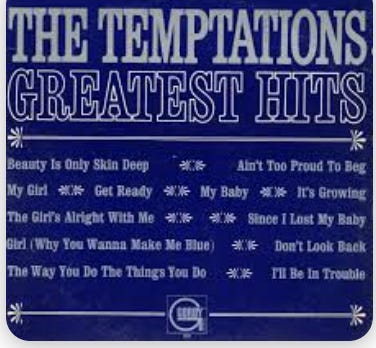
One of my favorite ever concert experiences was seeing them perform with Four Tops at Melody Fair in the early 90s. “My Girl” in person was a top memory.